How to Evaluate Wearables and Computer Vision AI for Workplace Safety: A Practical Framework
June 13, 2026
Organizations evaluating safety technology are increasingly comparing two very different approaches to risk visibility: connected-worker wearable technology and fixed camera computer vision systems.
Both approaches can provide valuable insights into workplace risk. However, they are built on fundamentally different architectures, collect different types of data, and are best suited for different operational environments.
As organizations invest significant resources into safety technology, the question should not be:
“Which technology is more advanced?”
Instead, leaders should ask:
“Which technology best aligns with our operations, workforce, infrastructure, culture, and risk profile?”
The Reality of Industrial Operations
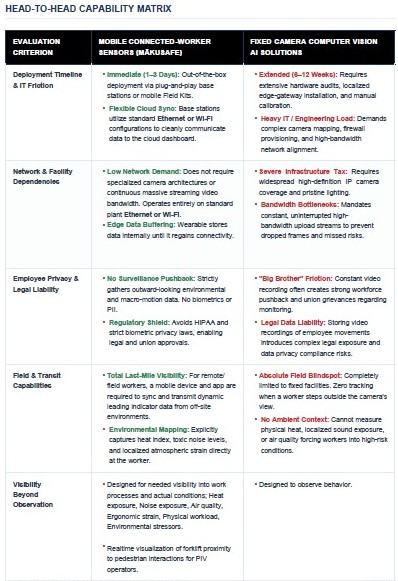
Many safety technologies are demonstrated in highly controlled environments with ideal network connectivity, pristine lighting conditions, and predictable workflows.
The reality for most industrial employers looks very different.
Workers move throughout manufacturing facilities, warehouses, distribution centers, loading docks, maintenance areas, outdoor environments, and customer locations. Many organizations also have contractors, drivers, service technicians, and remote personnel who spend portions of their day outside the four walls of a facility.
When evaluating safety technology, leaders should consider whether the solution is designed for real-world operational conditions—or whether it depends on ideal infrastructure and fixed environments to function effectively.
Five Critical Areas to Evaluate
1. Deployment Complexity
One of the first questions organizations should ask is:
How quickly can the technology begin delivering value?
Some technologies require extensive planning, infrastructure assessments, hardware installation, network configuration, and calibration before meaningful data can be collected.
Others can be deployed quickly and scaled across facilities with minimal disruption.
Deployment speed impacts not only implementation timelines, but also adoption, scalability, and time-to-value.
Organizations should evaluate:
- Required hardware installation
- Internal IT involvement
- Engineering resources
- Facility modifications
- Time to operational readiness
The easier a solution is to deploy, the faster organizations can begin identifying opportunities to reduce risk.
2. Understanding the Total Cost of Deployment
Technology costs extend far beyond software subscriptions.
Organizations should evaluate the full deployment model, including:
- Cameras and hardware
- Network upgrades
- Storage requirements
- Bandwidth consumption
- Edge computing devices
- Installation costs
- Ongoing maintenance
- Internal IT support requirements
In many cases, deployment complexity becomes as significant as the technology itself when scaling across multiple facilities.
The most successful implementations are often those that fit naturally within existing operational and technical environments.
3. Privacy, Trust, and Workforce Acceptance
Privacy and workforce trust are often among the most important factors in technology adoption.
Organizations should evaluate not only what a system measures, but how employees perceive the technology.
Important questions include:
- Will employees view the technology as surveillance?
- How will unions or worker representatives respond?
- What data is collected?
- How long is information retained?
- What legal and privacy obligations exist?
Technology adoption succeeds when employees understand the purpose of the solution and trust that it is being used to improve work—not simply monitor workers.
Building trust early can be just as important as selecting the right technology.
4. Risk Doesn’t Stay in Camera View
Many workplace risks occur beyond fixed production lines and designated workstations.
Workers move through:
- Warehouses
- Loading docks
- Yard operations
- Maintenance areas
- Outdoor environments
- Customer sites
- Remote work locations
When evaluating safety technology, leaders should consider whether visibility exists only where infrastructure is installed—or whether risk insights follow workers wherever work is performed.
This consideration becomes increasingly important for organizations with distributed operations, mobile workers, or environments where work frequently changes throughout the day.
5. Visibility Beyond Observation
Many safety technologies are designed to observe behavior.
Increasingly, however, safety leaders need visibility into conditions as well.
Examples include:
- Heat exposure
- Noise exposure
- Air quality
- Ergonomic strain
- Physical workload
- Environmental stressors
Understanding what workers are experiencing—not just what they are doing—can help organizations identify emerging risks before incidents occur.
This additional context can support more informed decision-making, targeted interventions, and proactive injury prevention efforts.
Technology Should Fit the Work
This discussion should not be framed as wearable technology versus camera technology.
In some environments, computer vision may be a valuable component of a broader safety strategy.
In others, wearable technologies may provide greater operational flexibility, broader coverage, or additional visibility into environmental and ergonomic risks.
The most important consideration is whether the technology aligns with:
- How work is actually performed
- The organization’s infrastructure
- Workforce expectations and culture
- Privacy and compliance requirements
- Operational objectives
- Long-term scalability goals
The best technology is not necessarily the one with the most features—it’s the one that aligns with how work is actually performed in your organization.
Download the Enterprise Evaluation Framework
To help EHS, Operations, Risk, Legal, and IT leaders evaluate these technologies more effectively, we’ve created an Enterprise Evaluation Framework comparing connected-worker wearables and computer vision AI across key operational considerations.
Inside the Framework:
✓ Deployment complexity and implementation timelines
✓ Infrastructure and network requirements
✓ Privacy and workforce acceptance considerations
✓ Environmental and ergonomic visibility
✓ Remote and field-worker coverage
✓ Operational scalability and deployment challenges
Whether you’re evaluating technology for a single facility or an enterprise-wide initiative, this framework provides practical questions and comparison criteria to help guide the decision-making process.
And be sure to…
Connect with one of our team of experts for a quick conversation!