AI Can’t Prevent What It Can’t See: Why Wearable Data Matters More Than Ever
November 11, 2026
As safety technology companies shift toward software and AI, the ability to capture reliable, real-world leading indicators of risk is becoming more important, not less.
The safety technology industry is evolving rapidly. Artificial intelligence, predictive analytics, and sophisticated software platforms are attracting significant investment, promising to help organizations make better decisions, reduce workplace injuries, and improve operational performance.
Interestingly, some companies that entered the market with wearable safety devices have moved away from developing or offering their own hardware, choosing instead to concentrate on software, analytics, insurance, or AI-driven services.
There are understandable business reasons for these decisions. Developing, manufacturing, supporting, and continuously improving hardware requires substantial commitment. But these changes raise an important question for employers investing in safety technology:
If we stop collecting meaningful information about the actual conditions and activities workers experience, what exactly will our AI be analyzing?
Strong AI Starts With Strong Data
Recent research from the American Society of Safety Professionals (ASSP) reinforces an important principle: data quality is foundational to effective artificial intelligence.
According to ASSP’s research on AI and ethics, data quality is a barrier for 62% of organizations at every stage of AI adoption.
This is especially relevant in environment, health, and safety.
For decades, safety professionals have relied heavily on incident reports, injury statistics, inspections, audits, and other historical records. These remain valuable, but they often tell us what happened after something went wrong.
AI can make analyzing these records faster and easier. It can identify patterns, summarize findings, and suggest actions.
But analyzing historical information more efficiently does not automatically give an organization greater visibility into the risks workers are encountering right now.
Better AI applied to incomplete data is still working with an incomplete picture.
That’s why the next generation of safety intelligence must be built on reliable leading indicators gathered directly from work as it is performed.
The Value of Seeing Work as Performed
Consider what happens during an ordinary shift in a warehouse, manufacturing plant, construction site, or distribution center.
Workers lift, carry, push, pull, bend, and repeat motions thousands of times. Environmental conditions change. Heat and noise exposures fluctuate. Forklifts and pedestrians share space. Workflows create bottlenecks. Equipment, staffing, and production demands influence how tasks actually get accomplished.
Most of this information is never captured in a traditional safety management system.
Yet these everyday conditions and activities can contribute to injuries, operational inefficiencies, fatigue, and other undesirable outcomes.
Wearable technology offers an opportunity to close that information gap.
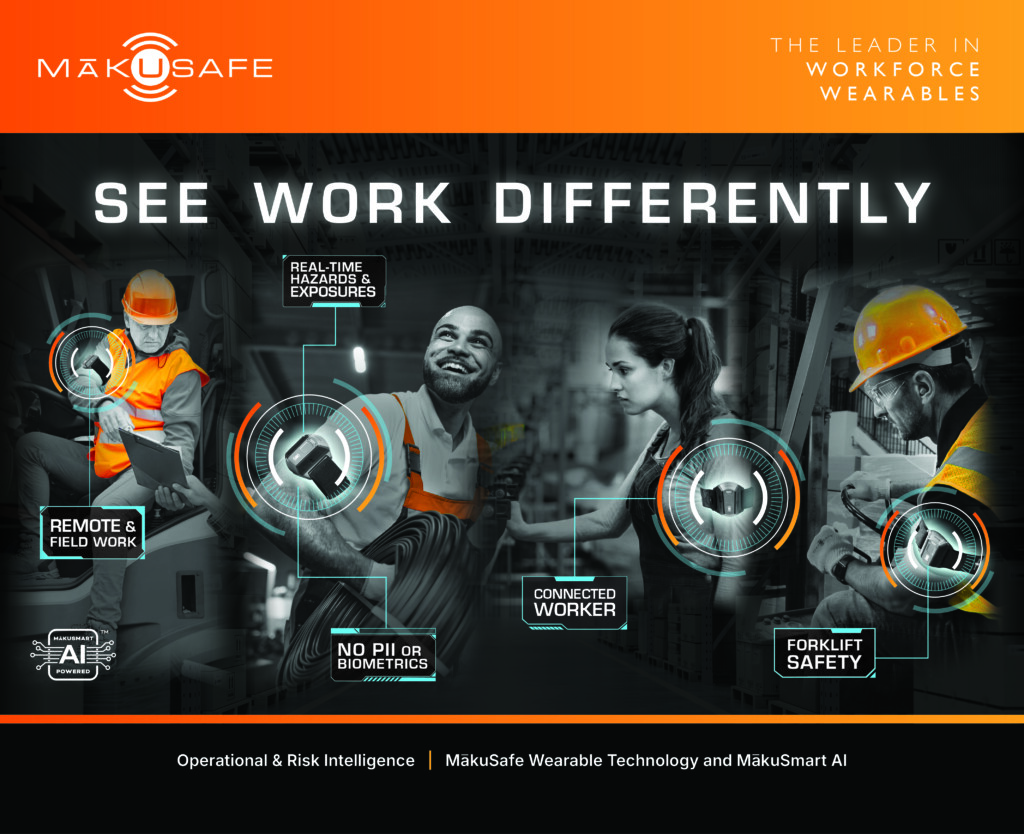
Modern wearable sensors can continuously collect environmental and motion-related leading indicators, helping organizations identify emerging risks and patterns that might otherwise remain invisible.
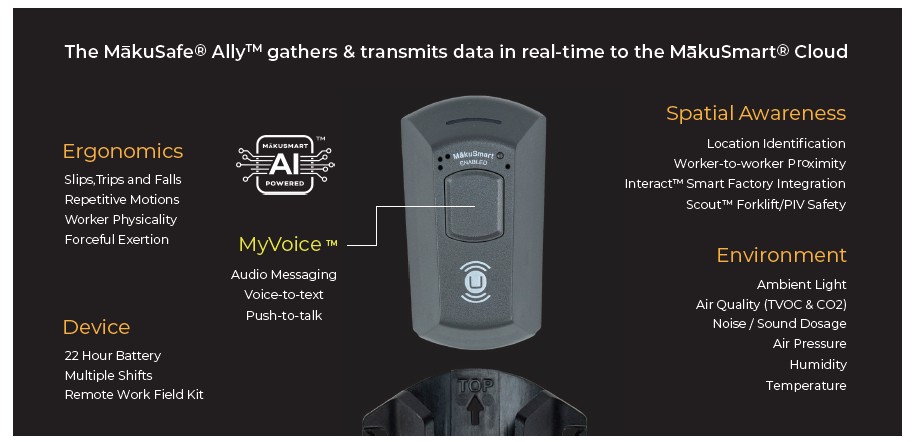
For example, MākuSafe’s Ally wearable gathers information about:
- Physical demands, including repetitive, forceful, and accelerated movements
- Slips, trips, and falls
- Temperature, humidity, and heat exposure
- Noise exposure and other environmental conditions
- Forklift and pedestrian interactions
- Worker-reported concerns, observations, and near misses
When this information is combined with analytics, it provides an objective, ongoing picture of how work is actually being performed.
Instead of relying exclusively on what happened yesterday, organizations can begin identifying opportunities to improve what happens tomorrow.
Wearable Technology Doesn’t Have to Mean Surveillance
One of the persistent challenges in wearable technology adoption has been the perception that collecting workplace data means monitoring individual workers.
It doesn’t have to.
MākuSafe was designed around a fundamentally different philosophy: understand the conditions and activities associated with risk without collecting biometric information or continuously tracking people.
The Ally wearable does not collect biometric data. It does not function as a continuous employee tracking system.
Nor does it rely on constant vibration, haptic feedback, or other personal alerts to interrupt workers throughout their shifts.
These distinctions matter.
Workers already manage numerous competing demands. Introducing technology that repeatedly alerts them to routine movements or conditions can create unnecessary distractions, alert fatigue, and frustration. In some circumstances, it can even shift responsibility for systemic workplace hazards onto the individual employee.
Our approach emphasizes identifying patterns, improving work design, and giving employers actionable intelligence to address risks at their source.
The objective isn’t to tell workers they’re doing something wrong.
It’s to understand what about the work could be improved.
That philosophy also aligns closely with Human and Organizational Performance (HOP) principles, which emphasize understanding how work actually happens rather than assuming procedures always reflect operational reality.
The Results Go Beyond Injury Prevention
Perhaps the strongest argument for collecting real-world leading indicators is that organizations are already demonstrating measurable results.
Across MākuSafe client deployments and insurance-related programs, reported outcomes have included:
- Reductions of approximately 50% in workers’ compensation claim frequency, with reductions in claims severity reaching 90% in certain programs
- Significant reductions in TRIR and lost time injuries, maintained for extended periods
- More than 80% reductions in forklift-pedestrian interactions at individual sites
- Extended periods without strain and exertion injuries
- Approximately 6% average productivity improvements in documented client applications
- Substantial increases in frontline reporting and engagement
- Significant workers’ compensation cost reductions and strong returns on investment
These results are not simply the product of wearing a device.
They come from collecting useful information, recognizing patterns, making informed decisions, and taking action to improve working conditions.
In one client application, analysis of forklift activity and operational workflows supported changes that generated more than $700,000 in annual labor savings.
This illustrates an important point: safety and operational performance are not competing objectives.
The same conditions that contribute to injuries can also create inefficiency, rework, delays, and lost productivity.
When organizations better understand work as performed, they can improve both.
Making Wearable Intelligence Easier and More Accessible
A legitimate challenge for wearable technology has always been implementation.
Organizations need solutions that are easy to deploy, economical to operate, and capable of fitting into real-world industrial environments without adding substantial administrative burden.
That’s why MākuSafe continues to invest in making data collection simpler and more flexible.
Our SiteLink technology has evolved beyond traditional network connectivity into wearable-to-wearable mesh networking, reducing dependence on facility Wi-Fi infrastructure.
Our Remote Worker FIELD KIT extends real-time risk intelligence to employees working outside traditional facilities, including route personnel, field service teams, and other distributed workers.
And MākuSmart AI allows safety and operations professionals to have a conversation with their own leading indicator data.
Rather than requiring specialized analytics skills, a safety manager can ask questions such as:
Where are our greatest ergonomic risks this week?
Which work areas are experiencing the highest heat exposure?
What operational patterns are contributing to forklift-pedestrian interactions?
Where should we focus our next safety observation or improvement initiative?
The system can help turn complex data into practical insights and recommendations.
For a small safety team, or even a safety team of one, that capability can dramatically expand the ability to recognize and prioritize risk.
Hardware and Software Are Better Together
The evolution of the safety technology market also presents new opportunities for collaboration.
Organizations that specialize in EHS software, ergonomics, risk management, or AI may not need to manufacture their own wearable devices to benefit from wearable-generated information.
Through integrations and partnerships, they can incorporate data collected by purpose-built wearable technology into their own applications.
MākuSafe has long recognized the value of these complementary relationships.
The future doesn’t necessarily require every software company to build hardware.
But it does require someone to capture reliable information about the real-world conditions and activities that software and AI are intended to improve.
And the broader, more accurate, and more relevant that information becomes, the more valuable the resulting intelligence can be.
The Future of Safety Intelligence Begins With the Real World
Artificial intelligence will undoubtedly play an increasingly important role in EHS and operational decision-making.
But AI alone cannot observe a physically demanding task, measure changing environmental conditions, recognize patterns of forklift interaction, or hear a frontline worker describe a concern.
Those capabilities require meaningful inputs from the real world.
At MākuSafe, we believe the future belongs to solutions that bring together unobtrusive data collection, meaningful worker participation, reliable connectivity, powerful analytics, and practical AI.
Not technology for technology’s sake.
Technology that helps organizations understand work, improve conditions, prevent injuries, and operate more effectively.
Because before AI can help us make better decisions about work, we need better information about the work itself.
Learn more about how MākuSafe combines wearable technology, real-time leading indicators, and AI-powered operational intelligence at makusafe.com.